
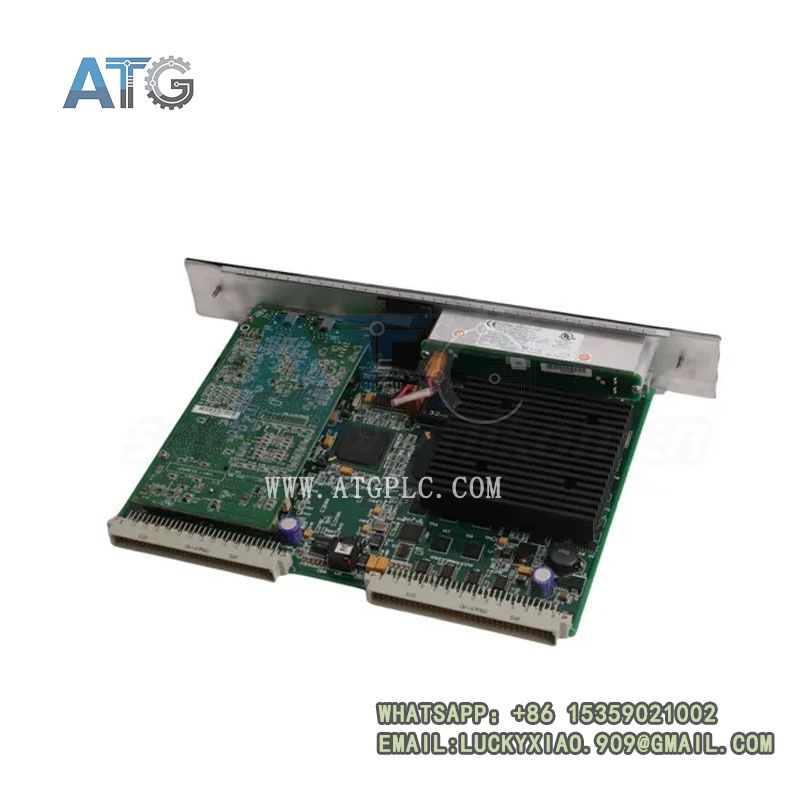

Description
Product Overview
The GE IC698CPE010 is the entry-level central processing unit of the PACSystems RX7i VME-based control platform. It occupies the first slot of an RX7i chassis and acts as the main logic engine for small and medium-sized automation systems.
GE designed it as the stepping stone between the legacy Series 90-70 world and the PACSystems architecture. The board keeps the familiar VME backplane and the familiar I/O family, while adding embedded Ethernet and a modern flash file system. That combination makes it a natural choice for retrofits where the cabinet stays but the processor moves forward.
At 300 MHz with floating-point support, it will not win any speed contests. Its role is steady, deterministic control for applications where scan time of a few hundred microseconds per thousand instructions is comfortable, not a bottleneck.
It is a simplex CPU. Redundancy is a separate product family within the same chassis, so mission-critical switchover needs should point elsewhere.
Product Features
The feature list on this board leans toward compatibility rather than peak performance.
- A 300 MHz Intel Celeron embedded processor executes Boolean logic at about 0.33 ms per 1000 contacts, which covers a wide range of machine and process applications.
- Battery-backed user memory and a 10 MB non-volatile flash retain programs, parameters and fault logs through power interruptions.
- Two embedded 10/100 Mbps Ethernet ports support EGD, SRTP and Modbus TCP/IP out of the box, with no separate communication module required.
- Three serial ports, RS-232 and RS-485, carry Modbus RTU Slave, SNP and Serial I/O traffic for legacy terminals and field devices.
- Up to 512 program blocks with a 128 KB block ceiling accommodate structured ladder, function block and C-language applications.
- A battery-backed real-time clock timestamps events and drives scheduled routines without an external clock module.
- Backward compatibility with Series 90-70 VME I/O modules protects existing hardware during platform migration.
- Energy-pack support offers battery-less dynamic data backup as an option, reducing a wear item in cabinets that never open.
Technical Specifications
| Item | Specification |
|---|---|
| Ordering model | IC698CPE010 |
| Product type | PACSystems RX7i central processing unit |
| Compatible platform | RX7i VME chassis; backward compatible with Series 90-70 VME I/O |
| Processor | 300 MHz Intel Celeron embedded, floating-point |
| Boolean execution | ~0.33 ms per 1000 Boolean contacts |
| User memory | 5 MB battery-backed RAM; 10 MB non-volatile flash |
| Discrete I/O memory | 32 K bits |
| Analog I/O memory | 32 K words |
| Program blocks | Up to 512; max 128 KB per block |
| Ethernet | 2 × 10/100 Mbps |
| Serial ports | 3 × isolated, RS-232 / RS-485 |
| Serial protocols | Modbus RTU Slave, SNP, Serial I/O |
| Ethernet protocols | EGD, SRTP, Modbus TCP/IP |
| Power input | +5 VDC from backplane, approx. 3.4 A |
| Redundancy | None, simplex CPU |
| Real-time clock | Battery-backed |
| Operating temperature | 0°C to +60°C with fan tray |
| Humidity | 5% to 95% RH, non-condensing |
| Mounting | Slot 1 of RX7i VME chassis |
| Certifications | CE, UL, industrial EMC |
Some distributor listings quote 10 MB of user RAM for this model. The conservative reading is 5 MB battery-backed RAM with a 10 MB flash filesystem, so size your application to the lower figure unless you confirm the exact memory variant.
Product Details
Knowing how this card sits in the rack saves time during both commissioning and spares planning.
Slot position. The CPU belongs in slot 1 of the RX7i backplane. A common rack-build error is filling the chassis first and discovering later that slot 1 was reserved.
Ethernet configuration. The embedded ports stay dead until an IP address is assigned. First commissioning visits routinely include a programming laptop and a crossover cable, so plan the first-site checklist accordingly.
Memory layout. Discrete, analog and symbolic memory draw from the same user RAM pool. Large analog tables can quietly consume room reserved for logic, which is why memory sizing deserves attention before the program grows.
Backup options. The board keeps volatile data through battery by default, and an energy pack replaces that battery where maintenance access is scarce. Pick one path and document it, because mixing configurations causes unexpected resets.
Migration position. This CPU reads Series 90-70 I/O natively, which lets a plant modernise the processor layer while leaving field wiring untouched. Ladder logic carries over, but C-coded blocks may need review.
What it is not. It has no built-in redundancy, no safety rating and no motion coprocessor. None of those are weaknesses; they simply explain which RX7i sibling to reach for next.
Application Fields
This CPU fits the middle of the market rather than the extremes.
Machine and line control. Packaging lines, conveyors and simple assembly cells run comfortably at the entry-level scan rate, and the dual Ethernet ports simplify HMI and SCADA connections.
Process utility skids. Water treatment, compressed air and auxiliary boiler control rarely push a 300 MHz CPU hard, and the serial ports absorb legacy instruments without a gateway.
Series 90-70 migrations. Plants upgrading from CPX or earlier Series 90-70 CPUs choose this board because existing racks, I/O and wiring mostly carry over.
Small to medium power and infrastructure control. Pumping stations, substation balance-of-plant and building automation systems benefit from the embedded Ethernet and the long product support cycle.
OEM equipment builds. Builders shipping standard machines value the predictable cost and the broad I/O compatibility.
Related Model Recommendations
- IC698CPE020 — 700 MHz Pentium III variant with 10 MB RAM, for programs that outgrow the entry CPU’s scan time.
- IC698CPE030 — 1.2 GHz high-end RX7i CPU with 64 MB memory, suited to large logic and heavy communications loads.
- IC698CRE020 — redundant CPU variant for hot-standby architectures where the CPE010’s simplex design falls short.
- IC697CPU780 — legacy Series 90-70 CPU, relevant when you are assessing exactly how far a migration from the older platform needs to go.