
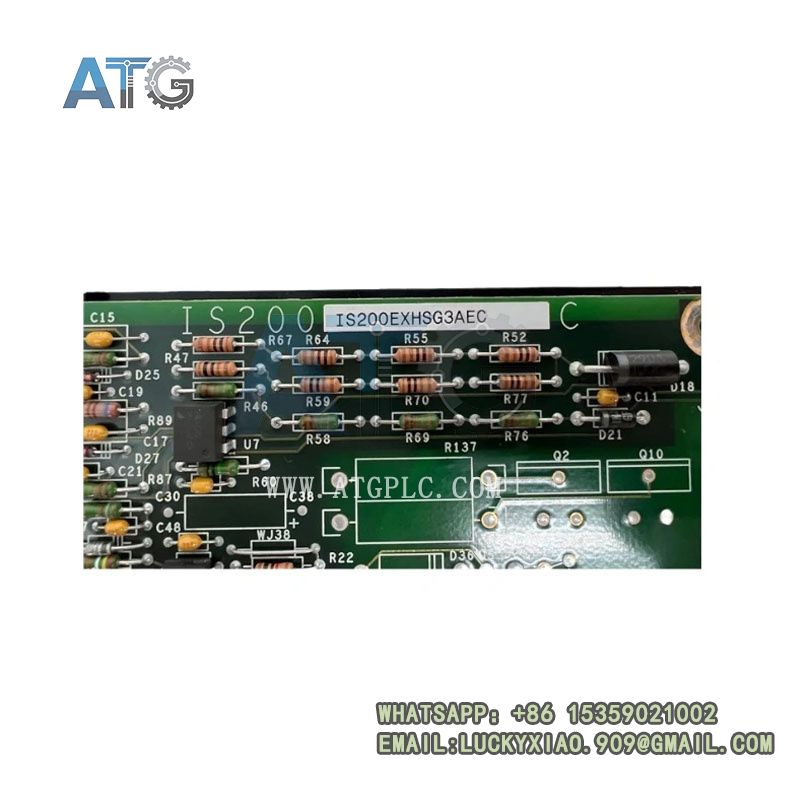

Description
Product Overview
The GE IS200EXHSG3REC is an exciter high-speed relay driver board built for the GE EX2100 and EX2000 generator excitation systems. It is the power interface between low-level control logic and the heavy-duty DC contactors that switch the generator field.
When the excitation controller decides to field-flash, de-excite or trip the field breaker, it sends a low-level logic command. This board amplifies that command into the current required to pull in DC contactors and pilot relays. It also conditions feedback from de-excitation crowbar circuits and passes that state back to the control layer.
The board plugs into the EX2100 exciter backplane. It supports both simplex and two-out-of-three (2oo3) voting redundant configurations, which is standard on large turbine generators where an unintended field trip can shut down a whole unit.
The G3REC suffix marks a specific revision within the EXHS family. The “REC” variant is the production configuration used on modern EX2100e excitation retrofits.
Core Product Features
- Drives the DC field contactors (device 41) that connect and disconnect the generator field, the most critical switching action in the excitation package.
- Operates pilot relays for field flashing and de-excitation sequences, which are required during generator start-up and fault trips.
- Provides regulated sustaining current with an initial current boost, so high-speed contactors pull in firmly without burning out their coils holding in.
- Conditions de-excitation and crowbar trip signals coming from EDEX and EXDE boards, and routes contact state feedback back to the controller.
- Supports 2oo3 voting redundancy, so three parallel driver boards must agree before a field contactor actually changes state.
- Galvanic isolation separates the 24 VDC pilot logic from the 125 VDC contactor drive side, protecting the control rack from field-side transients.
- On-board status LEDs show driver enable, contactor feedback and fault state for quick cabinet checks.
- Plugs directly into the EX2100 backplane with a screw-lock front connector, so no external wiring harnesses are needed for control signals.
Technical Specifications
| Item | Specification |
|---|---|
| Ordering model | IS200EXHSG3REC |
| Product type | Exciter high-speed relay driver board (EXHS) |
| Compatible system | GE EX2100 / EX2000 excitation control |
| Primary function | DC contactor and pilot relay drive for field flash / de-excitation |
| Driver channels | 6 per board (up to 12 across redundant set) |
| Contactor drive voltage | 125 VDC to field contacts |
| Pilot relay supply | 24 VDC |
| Input control voltage | 120 VAC nominal, 90–265 VAC range |
| Drive output | Regulated sustaining current with initial boost |
| Redundancy mode | Simplex or 2-out-of-3 voting |
| Feedback signals | De-excitation and crowbar status from EDEX / EXDE boards |
| Backplane interface | EX2100 exciter backplane, screw-lock front connector |
| Status indicators | Driver enable, contactor feedback, fault LEDs |
| Operating temperature | 0°C to +60°C |
| Dimensions | 8.64 cm × 16.18 cm |
| Weight | 0.91 kg |
| Mounting | Rack plug-in on exciter backplane |
| Origin | United States |
| Certifications | CE, UL, industrial EMC |
Some distributor listings quote 12 channels and Modbus or 4–20 mA interfaces. The EXHS board is a backplane-mounted relay driver, not a networked I/O module, so treat the 6-channel per-board count and backplane communication as the working baseline. Confirm the channel count against your exciter wiring diagram before ordering spares.
Product Details and Application Fields
Product Details
Where it sits. The EXHS board lives in the exciter cabinet, not the main turbine control rack. It receives commands from the EX2100 controller over the backplane and drives the field contactors mounted nearby. Distance between the board and the contactors matters, because coil current drops along long wires.
Boost-and-sustain drive. High-speed DC contactors need a big current spike to pull in, then a much smaller holding current. This board supplies both automatically. Skipping the sustain regulation causes coil overheating and early contactor failure.
Voting logic. In redundant EX2100e packages, three EXHS boards sit in parallel. A field contactor operates only when all three drivers command it. One stuck board cannot false-trip the field, and one failed driver cannot prevent a needed trip.
Crowbar feedback. When a de-excitation crowbar fires, the board picks up the contact closure and tells the controller. Without this feedback, the controller thinks the field is still energized during a fault event, which delays protective actions.
Revision context. G3REC is a late-production revision. Earlier G3AEC and G4A boards share the slot but differ in component values and drive circuits. When replacing a board, match the revision or verify compatibility with the exciter configuration tool.
Safety caution. The contactor side switches 125 VDC at field current levels. Any bench work on this board requires the field supply locked out and the field bank discharged. This is not a low-voltage logic card.
Application Fields
- Generator field contactor control in EX2100e excitation systems for steam and gas turbine generators
- Field flashing and de-excitation sequences in thermal and combined-cycle power plants
- Crowbar protection and field discharge switching for large synchronous generators
- 2oo3 redundant excitation packages on nuclear and utility-grade turbines
- Hydro generator excitation retrofit where legacy EX2000 boards are replaced with EXHS hardware
- Industrial cogeneration and captive power plant excitation control
Related Model Recommendations
- IS200EXHSG3AEC — earlier production revision of the same high-speed relay driver board, for legacy installations.
- IS200EXHSG4A — fourth-generation EXHS board with expanded I/O, used on newer EX2100e configurations.
- IS200EDEXH1A — de-excitation and crowbar control board that pairs with EXHS in the field discharge circuit.
- IS200ERDDH1ABA — excitation relay output driver board for auxiliary and alarm relays, complementing the high-speed contactor drive function.