
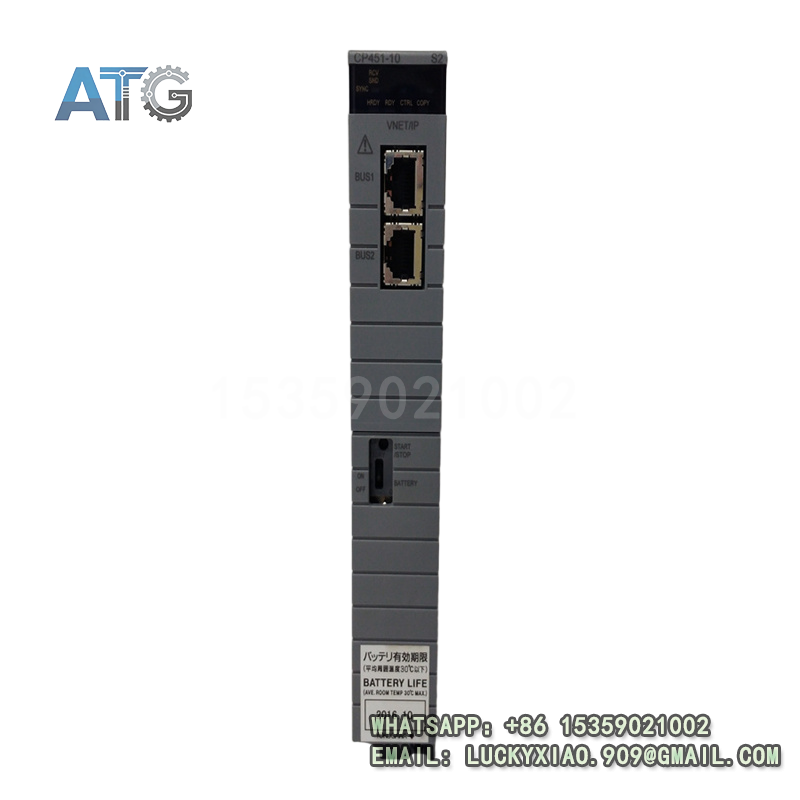
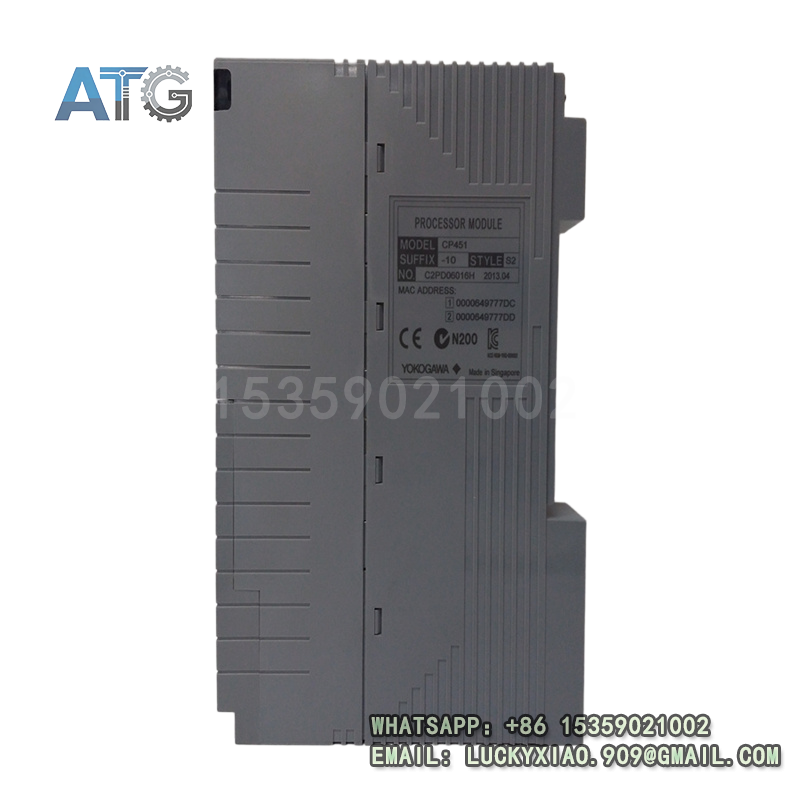

Description
YOKOGAWA CP451-10 Product Introduction
- Brand: YOKOGAWA (Yokogawa Electric Corporation)
- Model: CP451-10
- System: YOKOGAWA CENTUM VP / CENTUM CS 3000 Distributed Control System (DCS)
- Product Name: Processor Module (Central Processing Unit Module)
- Input Voltage: 24V DC (Allowable Fluctuation Range: 18V DC – 30V DC)
- Stock Quantity: 12
- Warranty: 12 months
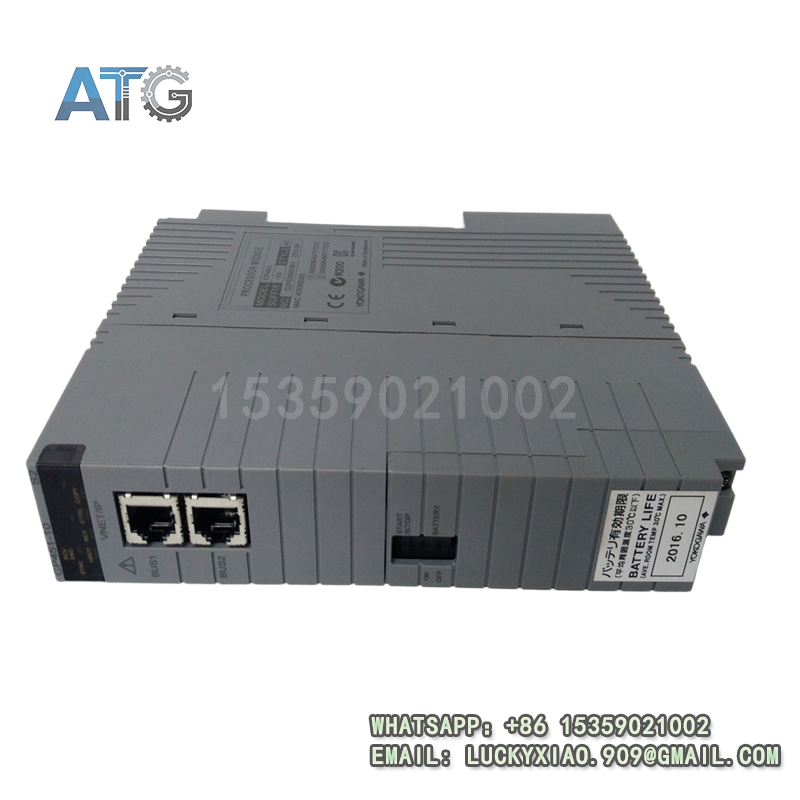
CP451-10
Real-World Application Case
A large petrochemical enterprise in Southeast Asia adopted the YOKOGAWA CP451-10 as the core processor module for its ethylene cracking unit, which consists of 11 cracking furnaces. The module undertakes the key tasks of real-time collection and processing of temperature, pressure, and flow parameters, as well as the execution of control strategies such as PID regulation. By integrating the CP451-10 into the CENTUM VP DCS, the enterprise realized closed-loop control of oxygen content in the combustion process of cracking furnaces, reducing gas consumption by 5% and shortening the response time of emergency shutdown signals from 200ms to 50ms[3]. In addition, the module’s dual redundancy configuration ensured 99.99% system uptime, avoiding unplanned shutdowns caused by equipment failures and directly reducing economic losses by over one million yuan[3]. This application fully demonstrates the high reliability and high performance of the CP451-10 in harsh industrial environments such as petrochemical production.
Main Functions
As the core component of the CENTUM VP / CENTUM CS 3000 DCS, the YOKOGAWA CP451-10 has a variety of core functions to meet the needs of industrial process control. Firstly, it has high-performance real-time control capabilities, equipped with a 32-bit RISC processor, supporting millisecond-level control cycles and various control algorithms such as conventional PID and cascade PID, which can efficiently execute complex control logic[4]. Secondly, it supports dual CPU redundancy configuration, which can realize seamless fault switching in milliseconds to ensure the continuity of the control process[4]. Thirdly, it has rich communication capabilities, integrating RS485, RS232 serial interfaces and Ethernet interfaces, compatible with Modbus RTU, Modbus TCP and Yokogawa’s dedicated K-Net protocol, enabling seamless connection with field instruments, HMIs and other equipment[4]. In addition, it is equipped with a complete self-diagnosis function, which can real-time monitor the operation status of the module itself and external interfaces, and send alarm information in time when abnormalities are detected to facilitate fault location and maintenance[4].
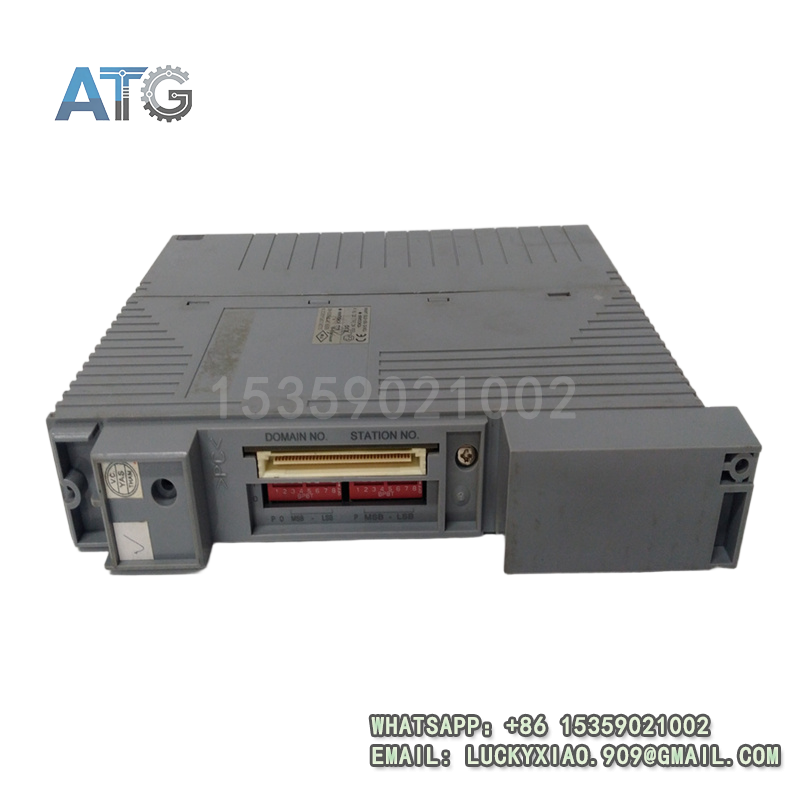
CP451-10
Technical Notes (Engineer’s Perspective)
From an engineer’s perspective, the following points need to be paid attention to when using the YOKOGAWA to ensure the stable and safe operation of the equipment. First, during installation, the module should be placed away from high temperature, high humidity, strong magnetic fields and corrosive gases, and sufficient installation space should be reserved in the control cabinet to ensure good heat dissipation[4]. Before wiring, the power supply must be cut off to avoid damage to the module or safety accidents caused by live wiring, and the positive and negative poles of the 24V DC power supply must be correctly connected to prevent reverse connection[4]. Second, when configuring the module, the firmware version should be checked to ensure it is compatible with the CENTUM VP / CENTUM CS 3000 system; if the firmware version is too low, it needs to be upgraded in time, but the upgrade process must follow the official operation guidelines to avoid program loss or module failure[4]. Third, regular maintenance is required, including cleaning the module surface dust, checking the connection tightness of the wiring terminals, and testing the redundancy switching function to ensure that the module can work normally when a fault occurs[3]. Finally, when replacing the module, it is necessary to confirm that the new module model is consistent with the original one, and the program and configuration parameters should be correctly imported to avoid system malfunctions caused by parameter mismatch[5].
Other YOKOGAWA Models Purchased by Customers
Customers who purchased the YOKOGAWA often choose other compatible models of the same brand to meet the needs of system expansion and matching. The most commonly purchased models include YOKOGAWA CP451-50, YOKOGAWA SCP451-11, YOKOGAWA S2, YOKOGAWA CS3000 and YOKOGAWA VP11. Among them, the CP451-50 is a high-performance enhanced version of the , with larger memory and stronger data processing capabilities, which is often used for large-scale process control scenarios[1][5]; the SCP451-11 is a specialized monitoring processor module, focusing on data acquisition and system monitoring tasks[1]; the S2 is an upgraded version of the , with optimized anti-interference performance[2]; the CS3000 and VP11 are key components of the same DCS system, which can form a complete control system with the to achieve more comprehensive industrial automation control.