
Description
1715-AENTR Allen-Bradley Product Introduction
- Model: 1715-AENTR
- Brand: Allen-Bradley (Rockwell Automation)
- Series: Allen-Bradley 1715 POINT I/O Communication Series
- Core Function: Industrial I/O data communication and conversion
- Type: Communication Module
- Key Specs: 24VDC, Ethernet/IP, 10/100 Mbps
- Supply Status: In Stock
- Stock: 45
- Warranty: 1 year
- Ship From: China
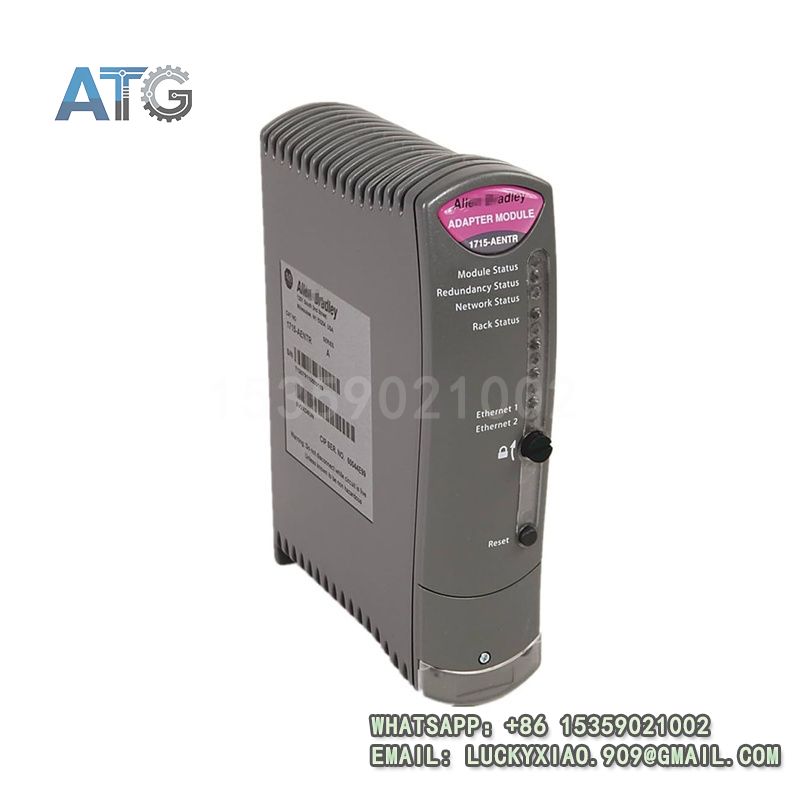
1715-AENTR
Product System Function Introduction
The 1715-AENTR is a high-reliability communication module under Allen-Bradley’s 1715 POINT I/O Series, specially designed to realize seamless data transmission and communication conversion between I/O modules and controllers in industrial automation systems. Its specific system functions are divided into the following points:
1. Functional Positioning and Core Value: As a key communication component of the 1715 POINT I/O Series, this module is positioned as an industrial I/O communication bridge, responsible for transmitting real-time data between field I/O modules (such as digital input/output, analog modules) and Allen-Bradley controllers. Its core value lies in realizing stable, high-speed data interaction, solving the communication connection problem between distributed I/O and controllers, and improving the integration and flexibility of the automation system.
2. Communication Performance and Stability: The module supports Ethernet/IP communication protocol as standard, with a communication rate of 10/100 Mbps, which can realize high-speed and real-time transmission of I/O data, reducing data delay and ensuring the timeliness of control signals. It adopts a dual-port Ethernet design, supporting daisy-chain or star topology connection, which is convenient for on-site wiring and system expansion. The internal circuit adopts advanced anti-interference design, with strong resistance to electromagnetic interference and voltage fluctuation, and can adapt to harsh industrial environments with high dust, strong vibration and large temperature changes, ensuring stable data transmission without packet loss.
3. Compatibility and System Integration: It is fully compatible with Allen-Bradley 1715 series POINT I/O modules (digital, analog, special function modules), and can be seamlessly connected with 1756 ControlLogix, 1769 CompactLogix, 5069 CompactLogix 5380 series controllers. It supports online configuration and parameter modification through Allen-Bradley Studio 5000 software, which is simple and convenient to operate. The module also supports device-level ring (DLR) function, which can improve the reliability of the communication network and realize rapid fault recovery when the network is interrupted.
4. Practicality and Fault Diagnosis: The module adopts a compact modular design, which is small in size and easy to install in control cabinets or distributed on-site. It is equipped with a built-in fault self-diagnosis function, which can timely detect communication faults, power supply abnormalities and module faults, and send alarm signals through indicator lights and software, facilitating maintenance personnel to quickly locate and handle faults. The low-power design ensures long-term stable operation, reducing the overall operation and maintenance cost of the system.
Application Industries
With its high communication speed, strong compatibility, high reliability and compact structure, the 1715-AENTR communication module is widely used in industrial automation projects that require distributed I/O communication and data transmission, mainly covering the following fields:
1. Automotive Manufacturing Industry: Applied in automobile assembly lines, parts processing workshops and distributed control systems, it realizes data transmission between on-site I/O modules (sensors, actuators) and controllers, ensuring the coordinated operation of the production line and improving production efficiency and control accuracy.
2. Petrochemical Industry: Used in chemical production workshops, pipeline control systems and distributed monitoring points, it transmits real-time data of temperature, pressure, flow and other parameters between I/O modules and central controllers, ensuring the safety and stability of the production process and adapting to the harsh on-site environment of the petrochemical industry.
3. Food and Beverage Industry: Applied in large-scale food processing and packaging lines, it connects distributed I/O modules (such as photoelectric sensors, proximity switches) with controllers, transmits production status data and control signals, ensures the consistency of product quality and the smooth operation of the production line.
4. Water Treatment Industry: Used in water supply and drainage systems, sewage treatment plants and distributed monitoring stations, it transmits data between I/O modules (flow meters, water quality sensors) and controllers, realizing real-time monitoring and control of the water treatment process, ensuring the stability of water supply and drainage and the safety of water quality.
5. Electronic Manufacturing Industry: Applied in electronic component processing, PCB assembly lines and distributed production stations, it realizes data transmission between on-site I/O equipment and controllers, ensuring the precise control of the production process and the accuracy of electronic components processing.
Usage Instructions
To ensure the long-term stable operation of the 1715-AENTR communication module and the smooth operation of the industrial automation communication system, the following usage instructions should be followed:
1. Installation Requirements: Install the module in a dry, well-ventilated control cabinet, avoiding direct sunlight, high temperature (above 65℃) and areas with strong vibration or heavy dust. Ensure firm installation and good contact with the backplane or mounting bracket to avoid poor contact caused by vibration. Keep a certain distance from high-voltage components to avoid electromagnetic interference, and ensure good ventilation around the module to prevent overheating.
2. Wiring Specifications: The module adopts 24VDC power supply. When connecting the power supply, strictly distinguish the positive and negative poles, and never reverse the connection to avoid short circuit burning the internal components. For Ethernet communication wiring, use standard twisted-pair Ethernet cables, ensure the wiring is firm and the contact is good, and the shielding layer of the cable should be properly grounded to reduce electromagnetic interference. It is strictly prohibited to wire with power on to avoid electrical shock or module damage.
3. Parameter Configuration and Debugging: Use Allen-Bradley Studio 5000 software to configure the module parameters, including communication parameters (IP address, subnet mask, gateway), network topology, DLR function settings and I/O module mapping. After the configuration is completed, download the parameters to the module and restart the module to make the configuration take effect. During debugging, check the communication connection status, ensure that the data transmission is normal, and adjust the parameters in time if there is packet loss or communication interruption.
4. Operation and Maintenance: During daily operation, regularly check the running status of the module (such as power indicator, communication indicator), and monitor the communication data through Studio 5000 software to ensure that the module is running normally. Regularly check the wiring for looseness, and clean the surface of the module to remove dust and stains. Regularly back up the module configuration parameters to a computer or storage device to prevent parameter loss due to unexpected power failure or module failure. When a fault occurs, use the fault diagnosis function of the software to locate the fault, and contact professional maintenance personnel for inspection and replacement if necessary.
5. Safety Precautions: Cut off the power supply of the entire system before installation, disassembly or wiring to prevent electrical shock or module damage. Do not touch the module pins, terminals or internal components with wet hands or metal tools to avoid short circuit. Avoid collision or impact on the module to prevent physical damage to the enclosure and internal components. In flammable and explosive industrial environments, strictly follow the on-site safety regulations and ensure that the module is used in a safe environment to prevent safety accidents.